
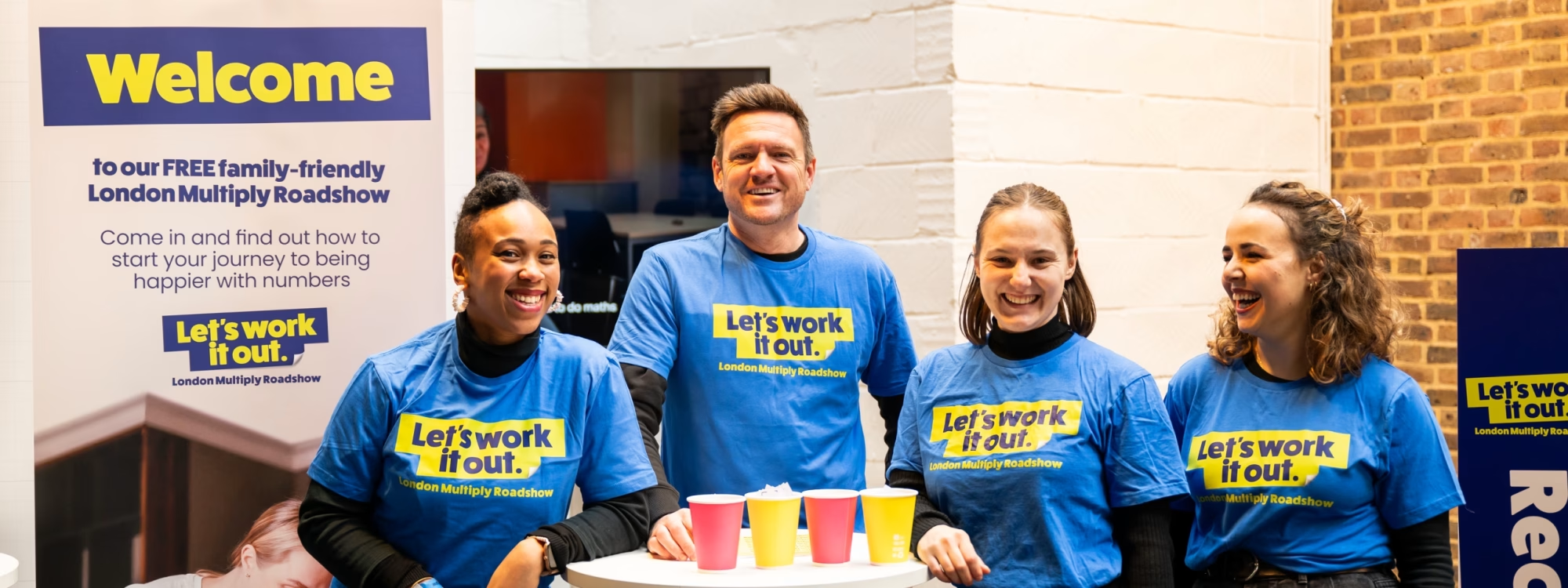
A roadshow is a great alternative to a single large event. It helps you reach more people with less travel, while creating a more personal and engaging experience, resulting in higher engagement, clearer understanding of key messages, lower costs, and a more sustainable way to deliver meetings and launches.
Choosing the right format for your roadshow is crucial. Get it right, and your roadshow can drive engagement, understanding, and long-term impact. Get it wrong and it can feel expensive, complicated, and disconnected.
In this guide, we will explore the main types of roadshows, look at which format might suit your business best, and share practical ideas to help you plan and deliver a successful roadshow.
What Is a Roadshow?
You may already have delivered a roadshow, or you may be planning your first one. At its core, a roadshow is a series of events, presentations or experiences delivered across multiple locations.
That said, roadshows are rarely that simple. There are many different approaches depending on your industry, your audience and your objective. Some roadshows repeat the same experience in every city to ensure consistency. Others are more flexible, adapting to each location and audience.
Either way, roadshows give you a valuable opportunity to meet your audience where they are, rather than asking them to come to you.
Broadly speaking, roadshows tend to fall into two main categories:
Consumer-facing (B2C) roadshows
These are designed to engage consumers through memorable, interactive experiences.
Internal corporate (B2B) roadshows
These are usually aimed at employees or stakeholders and often focus on training, education or internal communication. Consistency is key here, as everyone needs to receive the same message and experience.
The Two Main Types of Roadshows and Their Formats
B2C Roadshows: Creative and Bespoke Experiences
B2C roadshows are all about connection and memorability. They are designed to stop people in their tracks, spark curiosity and encourage interaction. Each location can be completely unique, with creative and bespoke builds tailored to the space and audience.
These roadshows are often immersive, hands-on, and most importantly, fun.
Common formats include:
- Pop-up experiences in public spaces or retail locations
- Immersive product demonstrations where customers can try before they buy
- Family-friendly activations with activities for both children and adults
- Luxury experiential tours for premium brands
- Educational tours with interactive workshops or exhibitions
These formats work particularly well for retail, luxury brands, education, and family or child focused sectors.
The strength of B2C roadshows lies in their flexibility and creativity. When done well, they leave a lasting impression that goes far beyond the event itself.
Internal B2B Roadshows: Consistent, Efficient and Sustainable
Internal roadshows are typically aimed at employees, teams or stakeholders. Unlike B2C roadshows, these usually follow a standardised format across every location, with consistency as the top priority.
The content, messaging and delivery remain the same, while the location changes. This ensures everyone receives the same information and experience, regardless of where they are based.
Typical formats include:
- Training sessions or workshops delivered across multiple sites
- In-house engagement tours where leadership teams visit offices with a consistent setup
- Sustainable, logistics-focused events designed for repeatability and reduced waste
- Talent and recruitment roadshows visiting universities or regional offices
These formats are well suited to industries such as finance, medical, public sector and recruitment.
Internal roadshows place a strong emphasis on operational efficiency and consistency. Using the same delivery team wherever possible helps maintain quality and ensures the focus stays on the message, not the logistics.
How to Know Which Roadshow Is Right for Your Brand
The best place to start is with your objective. Are you looking to drive product awareness, generate sales, train staff or communicate key business updates?
Once you are clear on that, ask yourself the following questions:
Who is your audience?
Are you speaking to consumers, families, students, employees or stakeholders? Your audience will shape whether your roadshow should be experiential, educational, or more operational.
What experience do you want to create?
Do you need a bold pop-up activation, an immersive product demo, a hands-on workshop, or a presentation-led roadshow delivered consistently across locations?
How flexible does the format need to be?
Some roadshows benefit from bespoke builds that adapt to each venue. Others work best with a repeatable setup that can be rolled out efficiently from site to site.
How interactive does it need to be?
Consider whether you need demonstrations, technology, activities and touchpoints, or whether a more structured, information led format is more appropriate.
What are the practical considerations?
Think about venues, travel, budgets, sustainability goals and how much time you have at each stop. These factors will help determine the size and complexity of your roadshow.
Once you have answered these questions, you should have a clear idea of the roadshow you want to deliver.
The good news is that you do not have to do it alone. Event companies like ours specialise in roadshows. We understand the moving parts, have strong venue and crew connections across the UK and beyond, and know how important consistency is from one location to the next.
With over 50 years of combined experience, we have delivered roadshows for some fantastic brands. We have recently partnered with Jet 2 to deliver their roadshow. Their B2B roadshow was designed for office-based teams, bringing people together to review performance and talk about future goals. Sparq delivered the programme across 11 offices, with each three-hour session supported by high-quality AV including PA systems, screens, microphones and uplighters. Wherever possible, we keep the same delivery team throughout, or at least one familiar face at each event, helping every session feel consistent, well run, and focused on the message.
Why B2C Roadshows Work
- They get people talking. Experiences are memorable and more likely to be shared.
- They create a real human connection. Face-to-face engagement builds trust in a way digital advertising cannot.
- They encourage participation through demos, activities and interaction.
- They help brands stand out in crowded markets.
- They drive social sharing, extending reach far beyond the event itself.
- They provide instant feedback, allowing brands to see what truly resonates.
Why Internal B2B Roadshows Work
- They avoid pulling large teams into one central location, reducing disruption.
- They save on travel and accommodation costs and reduce the risk of travel delays.
- They support consistent training and messaging across multiple sites.
- They are often more engaging and effective than online training.
- They allow time for questions, discussion and real understanding.
- They are particularly valuable for regulatory, compliance and policy updates.
Recent Trends to Improve Your Roadshow
The events industry is constantly evolving, and roadshows are no exception. A few current trends worth considering include:
- Using interactive technology such as AR, VR, or event apps
- Building social buzz by promoting tour stops and encouraging sharing
- Adding tailored or localised touches, even within B2B formats
- Focusing on sustainability by reducing waste and emissions
- Planning a thoughtful follow-up to keep audiences engaged after the event
Roadshows are a powerful way to connect with your audience and deliver a message at scale, but they are also complex projects. Sparq brings years of experience to every roadshow we deliver, across a wide range of industries. We know what works, what does not, and how to make your roadshow run stress-free. We are here to act as an extension of your team and support you wherever you need it.